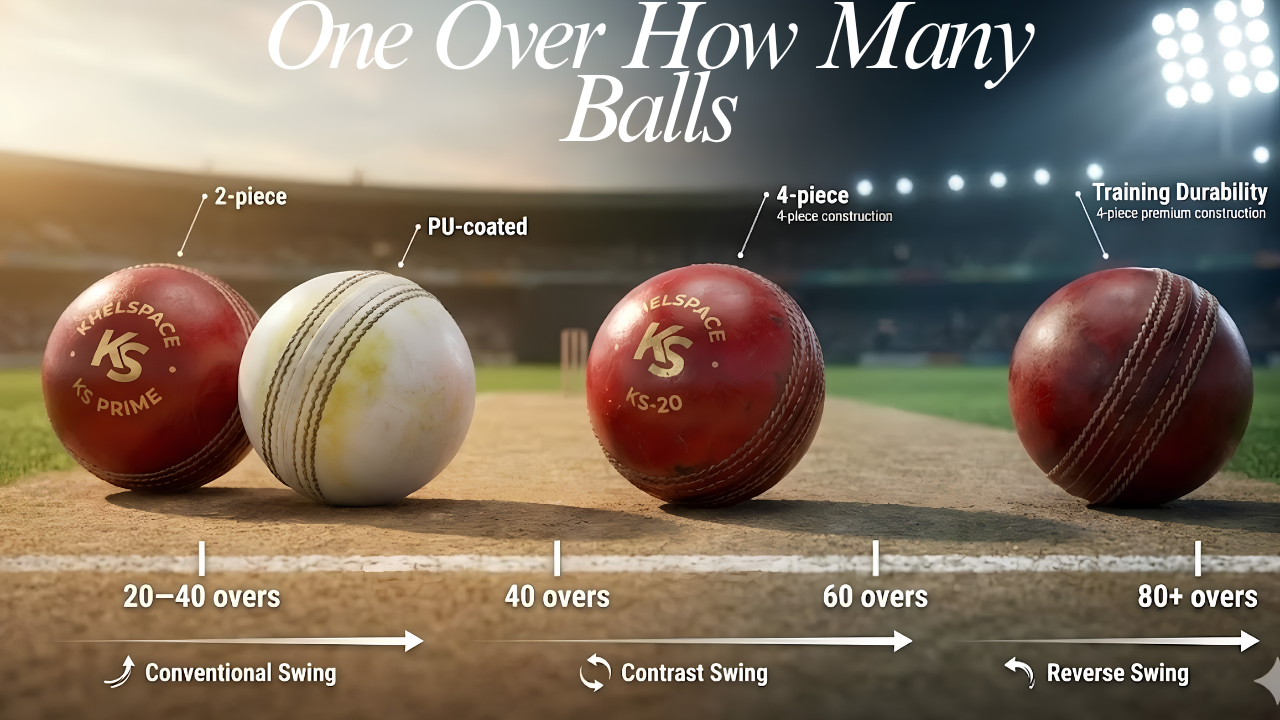
One Over How Many Balls: One of the hottest sports relay games internationally is cricket. It provides entertainment for millions of watchers and players every year. The most common question that a new person in cricket asks is, “How many balls are in an over in cricket?”
To put the long answer simply: one over, in cricket, consists of six legitimate balls. The over comes to an end after six leballs,alls and a new bowler delivers from the other end of the pitch.
Although the answer is quite straightforward, there are several key rules and some interesting trivia associated with overs in cricket. This is a basic guide to cricket where you learn all about overs, balls, no-balls, wides, match format history, etc. in very simple language.
What Is an Over in Cricket?
An over is a collection of six legal balls bowled from one end of the cricket pitch by a single bowler.
During an over:
- Each bowler delivers six legal balls.
- Scoring Runs.
- The team in the field bowls to take wickets.
- The over changes after six legal balls.
Another bowler bowls from the opposite end of the pitch for the next over.
One of the fundamental basics of cricket, overs help manage the tempo and structure of the game.
One Over How Many Balls? Simple Answer
Here is the direct answer:
| Cricket Term | Number |
|---|---|
| Balls in One Over | 6 |
| Legal Deliveries Needed | 6 |
| Overs in T20 Match | 20 per side |
| Overs in ODI Match | 50 per side |
So whenever someone asks, one over how many balls, the correct answer is six legal balls.
What Is a Legal Ball in Cricket?

Ball bowled by the bowler may or may not be count as ball on over.
A legal ball means:
- The bowler delivers the ball correctly.
- The delivery follows cricket rules.
- The umpire accepts the delivery.
However, if it is an illegal ball, it will not count among the six balls.
Balls That Do Not Count in an Over
At times, it happens that a bowler bowls an illegal delivery. These deliveries are called:
- Wide ball
- No-ball
In these deliveries, the batting team is awarded more runs and must be bowled again.
Read Also: Most International Wickets / Highest Runs in Test Cricket
Wide Ball in Cricket
Wide Ball: A wide ball occurs when the ball is out of reach and unable to be played properly by the batsman.
Important Points About Wide Balls
- The batting team gets 1 extra run.
- The ball does not count in the over.
- The bowler must bowl again.
Example
If a bowler bowls:
- 5 legal balls
- 1 wide ball
- 1 more legal ball
As only 5 legal deliveries were bowled before the extra delivery, the over is still not finished.
No-Ball in Cricket
Other illegal deliveries are a no-go.
It can happen when:
- The bowler is about to cross the crease line.
- The ball will be above waist height
- The bowler breaks bowling rules.
Important Points About No-Balls
- 1 run extra for the batting team
- It is not treated as a ball in over.
- In limited-overs cricket, one can be awarded a free hit.
Why Are There Six Balls in One Over?
In international cricket, six-ball overs are the norm nowadays. But this was not always the case.
Over the years cricket has evolved with various test nations following varying systems, such as using a different number of balls per over.
Historical Overlengths
| Country | Balls Per Over |
|---|---|
| England (Old Era) | 4 Balls |
| Australia | 8 Balls |
| South Africa | 8 Balls |
| Modern International Cricket | 6 Balls |
Later, the International Cricket Council (ICC) made six-ball overs the official standard.
Overs in Different Cricket Formats
Different cricket formats use different numbers of overs.
T20 Cricket
T20 is the shortest international format.
| Feature | Details |
|---|---|
| Overs Per Team | 20 |
| Maximum Balls | 120 |
| Match Duration | Around 3 Hours |
T20 cricket is fast, exciting, and full of big shots.
ODI Cricket
ODI means One Day International.
| Feature | Details |
|---|---|
| Overs Per Team | 50 |
| Maximum Balls | 300 |
| Match Duration | Around 8 Hours |
ODI cricket balances attacking and defensive gameplay.
Test Cricket
Test cricket is the longest format.
| Feature | Details |
|---|---|
| Over Limit | No Fixed Limit |
| Match Duration | 5 Days |
| Innings | 2 Per Team |
In Test cricket, teams continue batting until all wickets fall or innings are declared.
How Long Does One Take Over?
One over generally takes 3 to 5 min.
The time depends on:
- Bowler speed
- Field placements
- Wickets
- Umpire decisions
- Injuries
- DRS reviews
Although it may take a little longer for the fast bowlers compared to spin bowlers.
What Happens After an Over Ends?
When six legal balls are completed:
- The umpire calls “Over.”
- Fielding side changes bowling ends.
- The next over is bowled by another bowler.
- Batsmen swap ends.
This same process is repeated throughout the course of the match.
Can the Same Bowler Bowl Consecutive Overs?
A bowler cannot bowl two overs in succession from the same end.
The next over will have to be bowled by another bowler from the opposite end.
It is this balance of competition that the rule seeks to preserve within the game.
Read Also: The Hammer and the Scalpel / COD Name Ideas (2026)
Maximum Overs a Bowler Can Bowl
Each format has its own maximum on the number of overs bowled, as this can change from format to format.
| Format | Maximum Overs Per Bowler |
|---|---|
| T20 | 4 Overs |
| ODI | 10 Overs |
| Test | No Fixed Limit |
These also restrict one bowler from doing more than the requisite in short formats.
What Is a Maiden Over?
A maiden over is an over in which no runs are scored from the bat.
Example
If the bowler bowls:
- 6 dot balls
- No runs scored
Then it is called a maiden over.
Maiden overs create pressure on batsmen.
What Is a Wicket Maiden?
An even more rare feat, as it goes, is a wicket maiden.
It means:
- No runs scored
- At least one wicket taken
That is a great bowling companion, to say the least.
What Are Death Overs?
Death overs are the final overs of a limited-overs match.
In T20 Cricket
- Usually over 16 to 20
In ODI Cricket
- Usually over 41 to 50
These overs are very important because teams try to score maximum runs quickly.
What Is Powerplay in Cricket?
Powerplay is a period with fielding restrictions.
Powerplay Rules
| Format | Powerplay Overs |
|---|---|
| T20 | First 6 Overs |
| ODI | First 10 Overs |
During a power play:
- Fewer fielders are allowed outside the circle.
- Batsmen usually play aggressively.
Why Overs Are Important in Cricket
They manage the game in an organized manner.
They are important because they:
- Control match timing
- Balance batting and bowling
- Create strategies
- Help calculate run rate
- Decide match pressure
And not having overs would very soon put the cat among the pigeons in terms of running cricket.
Understanding Run Rate Through Overs
Run rate” means Runs scored in average / over
Formula
Run Rate = Total Runs ÷ Overs Faced
Example
If a team scores:
- 120 runs in 20 overs
Then:
120 ÷ 20 = 6
Run rate = 6 runs per over.
Highest Runs Scored in One Over
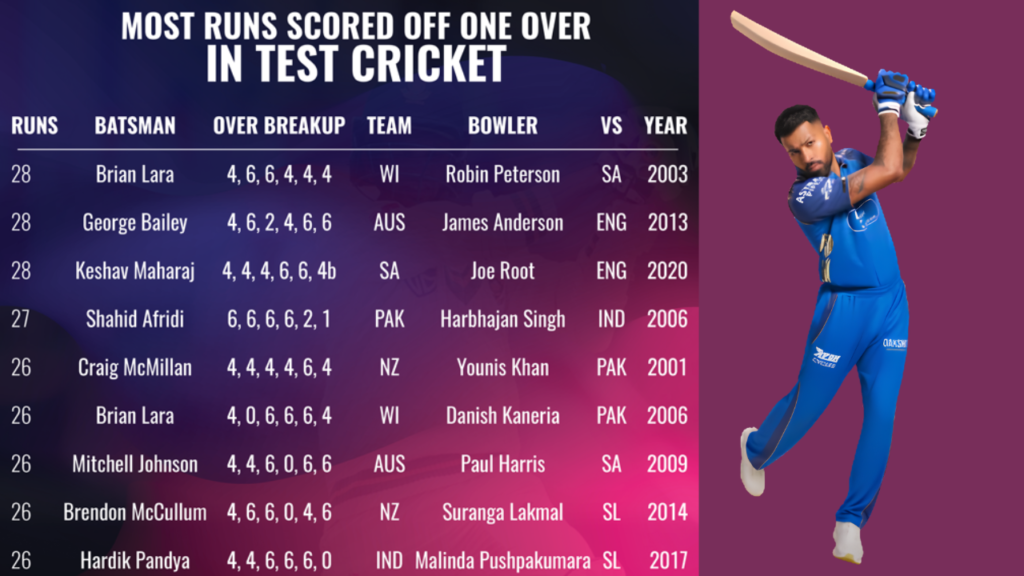
Sometimes batsmen score many runs in one over.
A perfect over with six sixes gives
| Shot | Runs |
|---|---|
| 6 Sixes | 36 Runs |
Some players have scored 36 runs in one over in professional cricket.
Most Common Bowling Terms Related to Overs
| Cricket Term | Meaning |
|---|---|
| Dot Ball | No run scored |
| Maiden Over | No runs in over |
| No-Ball | Illegal delivery |
| Wide Ball | Ball too wide |
| Yorker | Very full delivery |
| Bouncer | Short rising ball |
| Over Rate | Speed of bowling overs |
Interesting Facts About Overs in Cricket
1. Earlier Overs Had Different Ball Counts
In fact, it was normal for many years before six-ball overs became the standard in most countries to use 4-ball and 8-ball overs.
2. A Long Over Is Possible
An over can also get extremely long if a bowler bowls multiple wides and no-balls.
3. Fastest Over
Others bowl over in under two minutes.
4. Spin Bowlers Usually Bowl Faster Overs
Shorter run-ups mean that spinners will also tend to finish their overs much more quickly.
Common Beginner Mistakes About Overs
Newcomers to cricket sometimes get a few rules wrong.
Mistake 1: Thinking Every Ball Counts
Wide and no-ball deliveries are not considered
Mistake 2: Confusing Overs and Innings
An innings is a complete turn of batting, and an over consists of six balls.
Mistake 3: Believing Bowlers Can Bowl Unlimited Overs in T20
Whereas T20 bowlers have a maximum of four overs they can bowl.
Simple Example of an Over
Here is an easy example.
| Ball Number | Result |
|---|---|
| Ball 1 | 1 Run |
| Ball 2 | Dot Ball |
| Ball 3 | Four |
| Ball 4 | Wide Ball |
| Ball 4 Again | 2 Runs |
| Ball 5 | Wicket |
| Ball 6 | Six |
Because of the wide ball, the bowler had to bowl one extra delivery.
Importance of Overs in Match Strategy
Captains carefully plan overhauls.
They decide:
- Which bowler bowls in the power play?
- Which bowler bowls death overs
- When spin bowlers attack
- How to stop runs
At times, overmanagement helps teams to win matches.
How Umpires Count Overs
Each legitimate delivery is maintained by the umpire.
Traditionally:
- Umpires used fingers or counters.
Today:
- Electronic scoreboards help track overs.
Difference Between Balls and Overs
| Balls | Overs |
|---|---|
| Smallest unit in cricket | Group of six legal balls |
| One delivery | Six deliveries |
| Counted individually | Counted together |
Conclusion
One of the basic foundations of learning cricket is understanding one over how many balls A standard over consists of six legal deliveries. Note that wides and no-balls do not count, these must be bowled again.
Overs play a critical role in cricket matches as they help determine the structure, strategy & thrill involved. No matter if it is T20 or ODI or Test cricket, overs keep the game under control and adds excitement to moments for fans all across countries.
So now, when someone asks you “one over how many balls,” you can not only tell them the answer but also all about overs in cricket.
FAQs About One Over How Many Balls in cricket
Q. One over how many balls are there in cricket?
A. One over contains six legal balls.
Q. Do wide balls count in an over?
A. No, wides do not count.
Q. Do no-balls count in an over?
A. No, no-balls must be bowled again.
Q. How many overs are there in T20 cricket?
A. Each team gets 20 overs.
Q. How many overs are there in ODI cricket?
A. Each team gets 50 overs.
Q. Can one bowler bowl all overs?
A. No, bowling limits exist in shorter formats.
Q. What is a maiden over?
A. An over where no runs are scored.
About the Author