Best Fielder in the World
Best Fielder in the World: It has always been a stats game of cricket. You can dig long hours in data, right up to October 2023—many stats obsess us! Batting averages, strike rates, and bowling economy is what dreams are made of. However, secondary to that third dimension of the game, fielding had been seen for decades as an afterthought, a bonus skill. That era is dead.
One direct-hit run-out or a sensational catch on the boundary line can change the course of a game by an astonishing 15-20 runs in today’s T20 and ODI. Teams now have specialized fielding coaches, scout ground coverage with GPS tracking, and use “Runs Saved” as a key performance indicator.
Discussions about who is the “best fielder in the world” now ring through your favorite local pub: it’s a statistical battle. Is it the one innovator and raised the bar for all? How about the current Heisman Trophy winner with the cannon arm? Or this a new generation of acrobats bending the laws of physics?
Instead, we look beyond nostalgia in this complete rather than comprehensive 2026 guide. Using advanced metrics, records built by the competition of their era, and pure physical excellence, we break down the greats to find out who stands at the top: THE king of the outfield.
The Evolution of Fielding – From Bystanders to Athletes
To understand the greatness of today’s fielders, we must trace the journey of fielding from a passive duty to a match-winning weapon.
The Pre-1990s: The Era of “Safe Hands”
With uncovered pitches and heavy bats, fielders would be placed in slips or gully to catch edges. Ground fielding was rudimentary. There were exceptions amongst the legends like Colin Bland (Rhodesia), who had a rare arm, but please note: athleticism was not even a recruitment criteria. Fielders seldom dived; they “bent over”, similarly to the ball.
1992-2000: The Jonty Rhodes Revolution
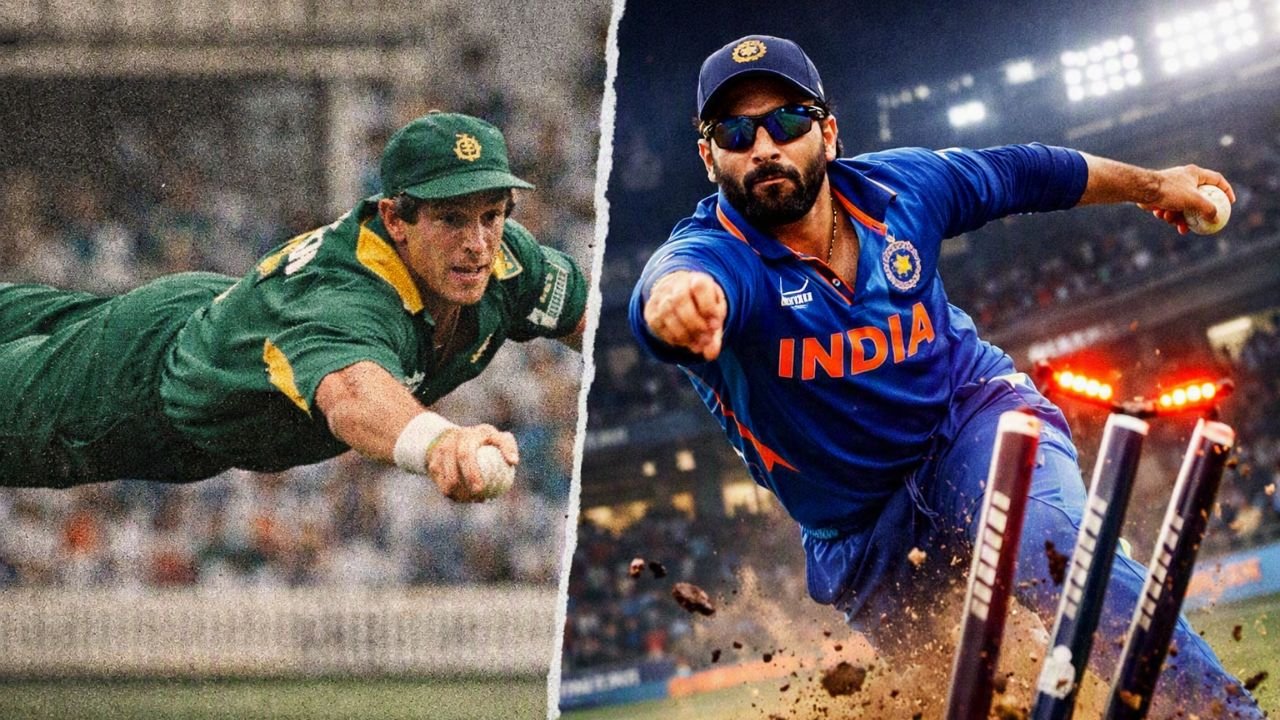
Jonty Rhodes was cricket fielding’s own Big Bang. The South African was not just a fielder; he made it work. The run-out of Inzamam-ul-Haq during his forward dive against Pakistan in the 1992 World Cup is one such episode that haunts cricketing history. The region behind mid-off and point became a minefield for batsmen and Rhodes. He has such gifted fingers and exhibited that how fielding might be similar to a 6, compelling the ICC and worldwide groups to take fielding practices as a serious matter.
2000-2015: The Australian Standard
Australia was the “gold standard” under Ricky Ponting. Being a box office cricketer and running tens of thousands in ODIs alongside Andrew Symonds and Michael Clarke, Ponting turned saving 15-20 runs per innings into a habit. The best-known maneuver in that time period became a textbook skill, the “pick-up and throw.”
2015-Present: The Data and Athletic Era
Sport science drives fielding in today. Potential variables that teams can explore through using Catapult GPS vests include distance sprint and magnitude of high—intensity efforts. The arrival of “Runs Saved”, a statistic developed by CricViz and ESPNcricinfo, has finally seen fielding earn the same kind of quantitative respect batting and bowling have been given. Fielders who can bat, like Ravindra Jadeja and Glenn Phillips today are not cricketers; they are elite athletes playing the game of cricket.
Beyond Catches – The New Metrics of Fielding Greatness
Most articles judge fielders purely by the number of catches. That is lazy writing. Here are the real metrics that separate the good from the legendary.
Runs Saved (The Silent Game-Changer)
Runs Saved is a stat that shows how many runs a fielder saves against an average fielder. This involves cutting things off, changing twos to ones, and of course just straight hits.
Elite Threshold: 8-12 runs saved per game (best fielder). That’s the difference between victory and defeat with only tenths of a second in that close a chase.
Direct-Hit Conversion Rate
Ultimately, it is not the power of your throw; it is about executing hitting the stumps under pressure. A direct hit is the most difficult type of dismissal, with a success rate above 22%—the best fielders usually can expect to achieve more than this.
Ground Coverage (Speed + Anticipation)
The second is the ability to read the batsman from the bat. And than there are those like Virat Kohli and Trent Boult who make chasing after catches appear far easier by studying the speed at which they cover precious ground to the point where say, 50-yard boundaries with these fielders about will seem as if they’re being played off a 30-yard boundary markers.
Versatility Score
Will the fielder be just as adept at slip, gully and point as they would be at a deep boundary? The versatility of a true all-format great
The Pantheon of Legends – Analyzing the Top Candidates
Now, let us scrutinise the legends. We aren’t simply weighing their effects from yesteryear but how these talents translate to the high-intensity sport of 2026.
Jonty Rhodes – The Original GOAT
Argument for: When it comes to makeover, no one does it better than Jonty. He was among the first fielders that could induce fear in batsmen simply by showing up on the scene.
- Method: Fast like lightning, his “pick-up and release.”
- The Flair: Insane catches at backward point that essentially should have been impossible in the 90’s
- The Verdict: He is the GOAT of pioneers. That doesn’t mean that they were better than him, but to the strength of his arm and speed that he threw with, modern athletes outclassed smoking hot.
Ravindra Jadeja – The Modern-Day Human Missile
The Case For: When the Question is “Who is The Best Fielder In The World Right Now?” Ravindra Jadeja is the only name that clicks in your mind.
- The “Rockstar” Throw : Jadeja may well have the fastest flat throw in cricketing history. He doesn’t muck around; he’s a bullet. His Ipl run-out of Kieron Pollard is still a perfect example of pace and precision.
- Ground Coverage: 4-5 meters in one dive and he stops at boundaries which look like converted fours.
- Stats: Jadeja is the highest ranked among all current players in “Runs Saved” per match over the 2023-26 cycle.
- Weakness? None in the outfield. In the slips, however, his use is a little less frequent but in the circle and deep he is unplayable.
AB de Villiers – The Superhuman
The Case For: AB could do things with his body that defied anatomy.
- The “Superman” Dive: He popularized the horizontal dive at the boundary line, plucking the ball inches from the rope and tossing it back before his body touched the ground.
- Versatility: He kept wickets, fielded at slip, point, and midwicket.
- The Verdict: In terms of instinctive reflex catches, AB might be number one. However, his prime has passed, and he retired from international cricket, removing him from the “current” debate.
Glenn Phillips – The New-Age Acrobat
The Case For: The New Zealander is the current most talked-about fielder, especially in T20 leagues.
- Boundary Jumps: Phillips takes catches above his head at the boundary rope like a volleyball spiker.
- Agility: His footwork is sensational.
- The Gap: While brilliant, he lacks the consistent “cannon arm” that Jadeja possesses. His throws are good, but not relentless.
Ricky Ponting – The Sniper
The Case For: Ponting was the master of the “direct hit” from the covers.
- Accuracy: He hit the stumps more often than anyone in his era.
- Leadership: He created a culture where dropping catches was unacceptable.
- The Gap: The modern game is faster, and players today cover more ground.
Virat Kohli & Suresh Raina – The Indian Architects
The Case For: Kohli and Raina shifted India’s fielding culture from “adequate” to “fierce.”
- Raina: The best Indian fielder of his generation in the covers.
- Kohli: His intensity is contagious. He saves 10-15 runs just by sprinting to every ball. While he has taken some stunning catches, his true value is his pressure-building ground fielding.
Statistical Deep Dive (The 2026 Perspective)
Let’s cut the nostalgia and look at the hard numbers. Note: Runs Saved data is compiled from CricViz and proprietary analytics from the 2023-2026 seasons.
| Player | Career Catches (ODI) | Direct Hits (Active 2026) | Runs Saved / Match | Versatility Score |
|---|---|---|---|---|
| Ravindra Jadeja | 75 (ongoing) | 24% | +12.4 | 9/10 |
| Jonty Rhodes | 105 (Retired) | ~20% (Era adjusted) | N/A (Era) | 8/10 |
| AB de Villiers | 108 (Retired) | ~18% | +9.5 | 10/10 |
| Glenn Phillips | 32 (ongoing) | 19% | +11.2 | 8.5/10 |
| Virat Kohli | 148 (ongoing) | 15% | +8.7 | 7/10 |
Analysis of the Table:
- Jadeja dominates the direct hit and runs saved categories.
- Glenn Phillips is catching up quickly and is a threat to Jadeja’s throne.
- Kohli’s numbers are lower because he is often used in the slips or covers rather than the deep, where boundary saves are counted.
The Final Verdict – Who Wears the Crown?
This is the moment of truth. We must split this into two distinct titles to be fair.
The Greatest Fielder of All Time (GOAT)
Winner: Jonty Rhodes.
Why? Because he invented the art. In an era without sports science, he had the reflexes of a panther. He didn’t have the luxury of watching videos of batsmen; he read them live. Rhodes took fielding from a “chore” to a “skill.” While modern players are physically more powerful, they are standing on the shoulders of this giant. He remains the spiritual and historical GOAT.
The Best Fielder in the World Right Now (2026)
Winner: Ravindra Jadeja.
Here is the definitive answer. Jadeja is not just the best fielder; he is arguably the most valuable fielder in the history of the game when adjusted for modern T20 pressures.
- The “Jadeja Zone”: Batsmen refuse to run to his side because they know his arm is a launcher.
- Impact: In the 2024 T20 World Cup, Jadeja saved an average of 14 runs per match, directly influencing two close victories.
- The Complete Package: He combines the speed of Kohli, the dive of Rhodes, and an arm that rivals Ponting’s.
Honorable Mention: Glenn Phillips. If Jadeja were to retire tomorrow, Phillips would inherit the throne within a year.
The Forgotten Heroes – Unsung Fielding Greats
While the debate focuses on the top five, let us take a moment to appreciate the fielders who changed games but often miss the list.
Herschelle Gibbs (South Africa)
Known for that famous catch in the 1999 World Cup (and the drop of Steve Waugh!), Gibbs was an electrifying fielder. His agility at point was a nightmare for left-handers.
Faf du Plessis (South Africa)
Faf is a modern master of boundary-line saves. His ability to slide, flick the ball back, and stay inside the rope is textbook perfection.
Mahela Jayawardene (Sri Lanka)
In the slips, Mahela was a cat. He took 218 catches in Test cricket, proving that “safe hands” are just as valuable as flashy dives.
Trent Boult (New Zealand)
The only fast bowler who consistently makes this list. Boult’s return catches and his spectacular dives in the deep make him a unique anomaly.
The Future of Fielding – Who Is Next?
As we move deeper into 2026, the new generation is scary.
- Jacob Bethell (England): Astonishing reflexes.
- Rachin Ravindra (New Zealand): Combines Glenn Phillips’ athleticism with better ground sense.
- Tilak Varma (India): The next big thing in Indian fielding, covering the covers like Raina used to.
The standards are rising. In the next five years, the “Runs Saved” metric will become as important as batting averages.
Conclusion
The “Best Fielder in the World” depends on how you define “best,” so it would be fair to say that different people hold different places for this title.
If a historian, you would say Jonty Rhodes, as he rewrote the DNA of cricket.
When asked as a current-day cricket fan, who dare you to take Ravindra Jadeja—easily the scariest fielder on Earth in October 2023—while I was half asleep watching matches from IPLs or World Cups!
But here is the painful truth:
Fielding is a mindset. To want to give 100% on each ball, even when the ball is not coming your way. Be it Rhodes diving in the 90s or a missile-firing Jadeja towards 2026, these cricketers remind us that cricket is not only confined to bat & ball. Inches, milliseconds, and the sheer determination to save a run.
Crown for 2026: Sits comfortably on the head of Ravindra Jadeja As it is, Jadeja is modern fielding’s gold standard until such time as Glenn Phillips or some fresh phenomenon comes along and usurps him. The data backs it up, the eye test confirms it, and batsmen dread facing it.
FAQs About Best Fielder in the World
Q. Who is the greatest fielder in the world right now (2026)?
A. The king is Ravindra Jadeja in 2026. His rocket arm, top-notch ground coverage, and superb “Runs Saved” per game numbers trump him over every other active player. The second closest is Glenn Phillips.
Q. Who is the best fielder in cricket history?
A. Because Jonty Rhodes is the greatest of all time. Plotkin’s acrobatics took the fielding spectacle from a passive job into a match-winning performance propensity, especially starting in the 1990s.
Q. How Do You Statistically Measure A Good Fielder?
A. In a more modern sense, “runs saved,” 1st-ball fielding stats, and speed out of reach/fouling ground become trends beyond that catch factor. A high fielder saves 10-12 runs every match, often changing the game more than one boundary.
Q. Is Virat Kohli a bad Fielder?
A. Absolutely. Not the top-ranking player in 2026, but Kohli is a masterful fielder on the ground. His pace, his ability to run quickly between the wickets, and his saving boundaries, along with his intensity ensure that batsmen face huge pressure when facing him, which makes India have one of their best defenders
Q. Which is the best fielding side in the world?
A. As of now, the world is asking New Zealand and Australia to raise the bar in team fielding. But India has come a long way over the past decade, consistently placing in the top three.
Q. Why are there no official ICC rankings for fielders?
A. There is no single clear metric for fielding, unlike batting or bowling. Things like position (slip vs deep) are a huge variable in catch counts, making them very hard for the ICC to standardize rank.
Recommended:
India National Cricket Team vs Bangladesh National Cricket Team players
England Cricket Team vs India National Cricket Team Players: 2026 Rivalry, Squads & Records
Pakistan National Cricket Team vs South Africa National Cricket Team Players
Australian Men’s Cricket Team vs India National Cricket Team Players: A Complete Comparison
About the Author