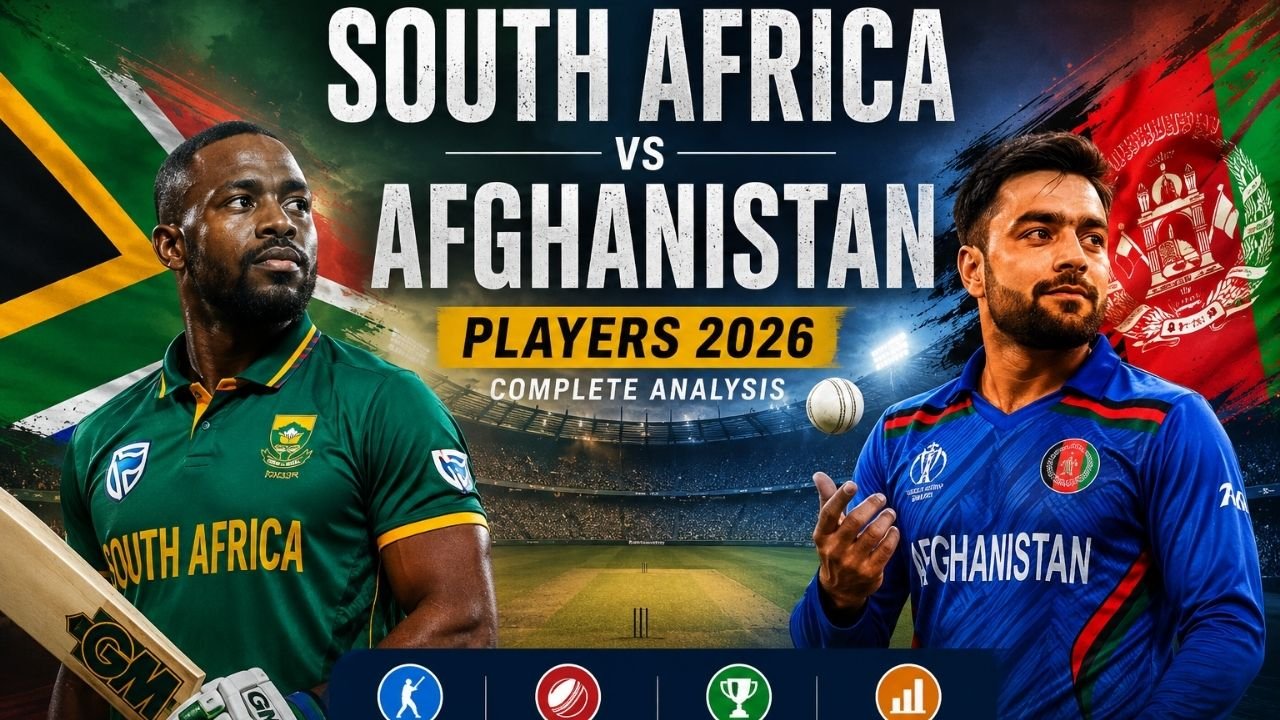
The players comparison between the South Africa National Cricket Team and Afghanistan National Cricket Team makes for much more fascinating reading than a court history of ranking would suggest. South Africa still have a more substantial horizontal structure to their international batting and pace-bowling depth, but Afghanistan are now a team who can bust conventional match scripts by spin, aggressive white-ball batting and career-defining individual performances.
The most recent record tells both stories. It was from that 2024 ODI series in which Afghanistan convincingly beat South Africa, and a comprehensive victory (by 177 runs) they achieved in the last encounter of that series at Bnagladesh that formulating of the 2025 Champions Trophy meeting started — when eventually South Africa scored marginally more than them earlier leading them a distance viewing closely as they put on ends for it; SA won by 107 for testing over its opponents outside home.
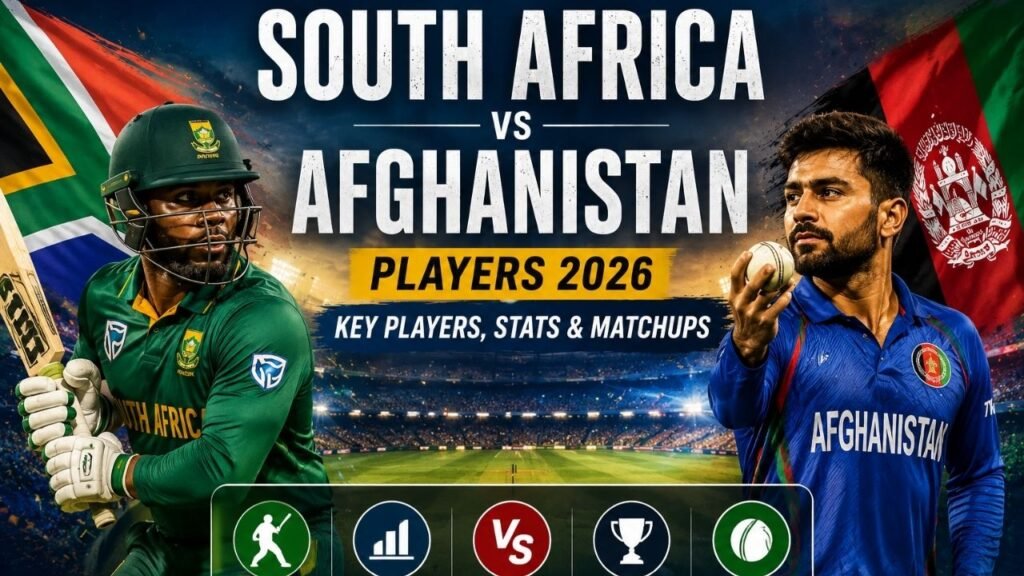
South Africa National Cricket Team vs Afghanistan National Cricket Team Players
South Africa’s biggest strengths are batting depth, fast bowling and experience in pressure matches. Players such as Aiden Markram, Heinrich Klaasen, Marco Jansen, Kagiso Rabada and Keshav Maharaj give the Proteas multiple ways to win.
Afghanistan’s greatest advantage is concentrated match-winning ability. Rashid Khan, Rahmanullah Gurbaz, Ibrahim Zadran, Azmatullah Omarzai, Mohammad Nabi and Fazalhaq Farooqi can change a game quickly, particularly when conditions favour spin or slower bowling.
The Afghanistan Cricket Board’s 2026 T20 World Cup squad included Rashid Khan as captain, Ibrahim Zadran as vice-captain, Gurbaz, Sediqullah Atal, Omarzai, Nabi, Noor Ahmad, Mujeeb Ur Rahman, Naveen-ul-Haq and Farooqi.
Are South Africa and Afghanistan good teams in 2026?
Yes, but their competitive advantages are different. South Africa offer greater structural depth across batting and bowling, while Afghanistan possess an unusually strong concentration of elite white-ball match-winners. The key variable is conditions: a flat surface can increase South Africa’s batting advantage, while a slower pitch can bring Afghanistan’s spin attack into the game.
Which players have the highest growth potential?
For South Africa, younger players such as Nqobani Mokoena, Connor Esterhuizen, Dian Forrester and Jordan Hermann represent an important next generation. South Africa included all four among the newer faces in their 2026 T20I setup.
For Afghanistan, Sediqullah Atal, Noor Ahmad and Azmatullah Omarzai are particularly important because they extend Afghanistan’s competitive window beyond the Rashid-Nabi generation.
Who has the stronger bowling attack?
There is no universal answer. South Africa have the more conventional pace-bowling advantage, while Afghanistan have the more unusual spin advantage. On a fast pitch, South Africa’s seamers become more valuable; on a gripping surface, Afghanistan’s combination of Rashid Khan, Noor Ahmad and other spinners can dictate the innings.
Who has the better head-to-head record?
South Africa have the stronger overall record in the commonly recorded international head-to-head, with five wins to Afghanistan’s two across seven matches listed in recent databases. However, that aggregate hides a much more competitive recent rivalry, including Afghanistan’s 2024 ODI series win in the UAE.
South Africa Players: The Core Match-Winners
South Africa’s selection philosophy has increasingly revolved around creating multiple pathways to victory rather than relying on one superstar.
Aiden Markram
Aiden Markram is one of South Africa’s most strategically valuable players because he can influence several phases of a white-ball match.
His batting allows South Africa to change gears without completely restructuring the innings. His off-spin also gives the captain an additional tactical option when the primary bowlers need a break.
Against Afghanistan, Markram’s value is even greater because a captain may need flexible bowling options when confronting a batting order designed to attack spin.
Heinrich Klaasen
If there is one South African batter Afghanistan cannot afford to underestimate, it is Heinrich Klaasen.
Klaasen’s reputation has been built around his ability to attack spin and transform the middle overs from a consolidation period into a scoring opportunity.
That creates a tactical contradiction for Afghanistan. Their spin attack is one of their greatest weapons, but Klaasen is exactly the type of batter capable of reducing its impact.
The Klaasen-versus-spin battle can therefore become the tactical centre of the match.
Marco Jansen
Marco Jansen offers South Africa something Afghanistan cannot easily replicate: left-arm pace combined with batting ability.
His height creates awkward release angles, particularly when he attacks the stumps or uses bounce intelligently. His batting also provides additional lower-order insurance.
Jansen’s importance increases if South Africa lose early wickets. He gives the team a route to rebuild without sacrificing all late-innings power.
Kagiso Rabada
Kagiso Rabada remains one of the most important pressure bowlers in the South African structure.
His role is not simply about taking wickets. The bigger advantage is his ability to attack established batters and force an opposition to change its scoring plan.
Against Afghanistan, Rabada’s early overs could be particularly important against Gurbaz and Ibrahim Zadran.
Keshav Maharaj
Keshav Maharaj represents the other side of South Africa’s bowling equation.
Where Rabada provides pace and penetration, Maharaj provides control and tactical pressure. His importance becomes even greater if Afghanistan’s middle order is forced to play a large number of deliveries against spin.
Afghanistan Players: Why the Underdog Narrative Is Outdated
Calling Afghanistan an “underdog” can actually obscure the tactical problem they create.
They no longer need every player to outperform his South African counterpart. They need two or three of their highest-impact players to win specific battles.
That is a very different proposition.
Rashid Khan
Rashid Khan remains the central figure.
The Afghanistan Cricket Board selected Rashid as captain for the 2026 T20 World Cup squad, underlining his importance to the team’s leadership and bowling structure.
Rashid’s value comes from uncertainty. Batters know they cannot simply survive him with conventional defensive cricket because his pace through the air, variations and attacking length can force mistakes.
Recent head-to-head data also places Rashid at the top of the wicket-taking list in this rivalry, with nine wickets in the recorded meetings.
Rahmanullah Gurbaz
Rahmanullah Gurbaz is Afghanistan’s volatility engine.
When Gurbaz starts quickly, Afghanistan can force a captain to abandon the original bowling plan within a few overs.
His attacking approach carries risk, but that is precisely the point. Afghanistan do not necessarily need a conservative opening partnership against South Africa. They can gain more from early disruption.
Ibrahim Zadran
Ibrahim Zadran provides a different batting profile.
Where Gurbaz can create immediate pressure, Ibrahim is capable of absorbing early movement and building a longer innings. The combination gives Afghanistan two different opening gears.
In 2026, his leadership responsibilities have also increased. The Afghanistan Cricket Board named him vice-captain for the T20 World Cup squad and later announced him as T20I captain for the Sri Lanka series.
Azmatullah Omarzai
Azmatullah Omarzai is arguably one of Afghanistan’s most important transitional players.
He bridges batting and bowling. That matters because Afghanistan’s biggest historical concern has been whether they can maintain balance when their premier bowlers do not dominate.
Omarzai helps solve that problem.
Fazalhaq Farooqi
Fazalhaq Farooqi gives Afghanistan a left-arm pace option that can challenge South Africa’s top order from a different angle.
His value is particularly high in the powerplay, where early movement or changes of angle can prevent South Africa from immediately establishing a high scoring rate.
South Africa vs Afghanistan Players: Head-to-Head Reality
The rivalry has produced some remarkably different results.
| Match | Result |
|---|---|
| 2019 World Cup | South Africa won by 9 wickets |
| 2023 World Cup | South Africa won by 5 wickets |
| 2024 T20 World Cup semi-final | South Africa won by 9 wickets |
| 2024 ODI, 1st match | Afghanistan won by 6 wickets |
| 2024 ODI, 2nd match | Afghanistan won by 177 runs |
| 2024 ODI, 3rd match | South Africa won by 7 wickets |
| 2025 Champions Trophy | South Africa won by 107 runs |
These results demonstrate why a simple “better team” label is inadequate.
Afghanistan have already shown that they can dismantle South Africa in ODI cricket. South Africa, however, have repeatedly responded strongly in major ICC tournaments.
That suggests a fascinating psychological and tactical pattern: Afghanistan can dominate the matchup when the game becomes chaotic, while South Africa benefit when they impose a controlled structure.
The 2026 T20 World Cup Changed the Conversation
The 2026 T20 World Cup meeting was especially revealing.
South Africa and Afghanistan played a dramatic match that went into a double Super Over, with South Africa eventually winning the contest. The result demonstrated how narrow the margin between these teams can become in T20 cricket.
This matters more than a routine group-stage win.
A team that can push South Africa into two Super Overs is not merely participating in the tournament. It is capable of creating genuine late-game pressure against a side with a deep international pedigree.
The market-style takeaway is simple: Afghanistan’s floor has risen.
Key Player Battles That Could Decide the Match
1. Heinrich Klaasen vs Rashid Khan
This is arguably the most important matchup.
Rashid wants to restrict Klaasen’s ability to attack through the middle overs. Klaasen wants to turn spin into a scoring opportunity.
If Rashid wins, Afghanistan can squeeze South Africa’s middle order.
If Klaasen wins, South Africa may enter the final overs with a platform for a massive total.
2. Kagiso Rabada vs Rahmanullah Gurbaz
This is a classic aggression-versus-aggression contest.
Gurbaz will want to score before South Africa establish control. Rabada will want to challenge him before he reaches rhythm.
An early wicket changes the expected structure of the innings.
3. Marco Jansen vs Ibrahim Zadran
Jansen’s bounce and angle against Ibrahim’s patience create another important battle.
Ibrahim’s success would allow Afghanistan to build an innings around their explosive middle order. Jansen’s success could expose Afghanistan to the quality of South Africa’s deeper bowling options.
4. Keshav Maharaj vs Afghanistan’s Right-Handers
Maharaj’s control can be especially valuable against Afghanistan’s middle order.
If he prevents boundaries while taking wickets at the other end, Afghanistan may be forced to accelerate earlier than planned.
Where South Africa Have the Edge
We see four structural advantages.
- Greater batting depth
- More established pace-bowling resources
- Experience in high-pressure ICC matches
- More options when Plan A fails
The fourth point is often ignored.
A strong international team is not necessarily the team with the best XI. It is often the team that has the best second plan.
South Africa have repeatedly demonstrated that flexibility.
Where Afghanistan Have the Edge
Afghanistan’s advantages are more concentrated but potentially more dangerous.
Elite spin
Rashid Khan and Noor Ahmad give Afghanistan an unusual ability to attack batters from different angles.
Aggressive opening
Gurbaz can create scoreboard pressure before South Africa’s bowlers settle.
All-round depth
Omarzai, Nabi and Naib allow Afghanistan to construct an XI with multiple skill combinations.
Match-up disruption
Afghanistan are particularly dangerous when conditions make conventional batting difficult. They can turn a 170-run expected game into a 140-run tactical contest and make every wicket disproportionately valuable.
The Risk Factor: Why Player Names Alone Can Mislead
The biggest mistake in analysing this matchup is assuming star power automatically converts into performance.
It does not.
A player can be world-class and still be the wrong tactical fit for a particular surface.
For South Africa, excessive dependence on top-order batting could become dangerous if Afghanistan’s spinners control the middle overs.
For Afghanistan, over-reliance on Rashid Khan creates the opposite risk. If South Africa neutralise Rashid, the burden on the remaining bowling attack increases sharply.
The same principle applies to batting.
If Gurbaz fails early and Afghanistan lose Ibrahim soon afterwards, the middle order may be asked to rebuild rather than attack.
In cricket, concentration of talent is an advantage until the opponent identifies the concentration point.
Players With the Highest Growth Potential in 2026
South Africa
Nqobani Mokoena is particularly interesting. His breakthrough in the SA20 earned him a national call-up, while Connor Esterhuizen, Dian Forrester and Jordan Hermann were also identified among the emerging T20I options.
These players matter because South Africa are not simply trying to win the next match. They are building a deeper talent pool around their established international core.
Afghanistan
Afghanistan’s next phase is equally important.
Sediqullah Atal represents batting depth, while Noor Ahmad offers another high-value spin option. Omarzai provides the all-round balance that modern T20 teams increasingly demand.
The ACB’s 2026 selections also showed an active effort to refresh the squad, including the return of Mujeeb Ur Rahman and Naveen-ul-Haq for the T20 World Cup setup.
South Africa vs Afghanistan Players: Statistical Snapshot
| Category | South Africa | Afghanistan |
|---|---|---|
| Major batting strength | Klaasen, Markram, Miller | Gurbaz, Ibrahim, Omarzai |
| Spin leader | Keshav Maharaj | Rashid Khan |
| Pace leader | Rabada | Farooqi |
| All-round depth | Jansen, Markram, Mulder | Omarzai, Nabi, Naib |
| Major tactical advantage | Depth | Disruption |
| Key risk | Over-reliance on top order | Concentration of responsibility |
| Best conditions | Pace-friendly surfaces | Slower/spin-friendly surfaces |
What We Should Watch First
When analysing a future South Africa-Afghanistan match, we should focus on five signals rather than relying only on pre-match rankings.
- The first six overs: Can Afghanistan attack South Africa’s new-ball bowlers?
- Rashid’s spell: Does South Africa attack him or attempt to survive?
- Klaasen’s position: When does South Africa unleash its biggest spin-hitter?
- Wickets in hand: Which side reaches the final five overs with more batting resources?
- Pitch behaviour: Does the surface reward pace, strokeplay or grip?
These indicators often tell us more than a list of famous players.
South Africa National Cricket Team vs Afghanistan National Cricket Team Players: Final Verdict
South Africa enter the matchup with the more complete cricketing structure. Their batting depth, pace resources and experience make them difficult to destabilize.
Afghanistan, however, have something equally valuable in short-form cricket: the ability to turn a structured contest into an unpredictable one.
Rashid Khan remains the central threat, while Gurbaz, Ibrahim Zadran, Omarzai, Noor Ahmad and Farooqi provide enough support to make Afghanistan dangerous even when one major player fails.
For South Africa, the clearest route to control is to prevent Afghanistan’s best players from dictating the tempo. For Afghanistan, the objective is almost the reverse: create enough disruption that South Africa’s depth becomes irrelevant.
That is why the South Africa National Cricket Team vs. Afghanistan National Cricket Team players debate should not be reduced to star rankings. The decisive question is which side can force the other to play outside its preferred game model.
Conclusion
The South Africa-Afghanistan rivalry has moved beyond a simple established-team-versus-emerging-team narrative. South Africa offer depth and adaptability; Afghanistan offer elite spin and disruption.
The smartest way to assess the matchup is to watch the key battles—Klaasen vs Rashid, Rabada vs Gurbaz and Jansen vs Ibrahim—because those contests can determine whether the game follows South Africa’s structure or Afghanistan’s chaos.
For readers tracking future fixtures, the action strategy is straightforward: check the confirmed XI, assess the pitch, identify the key matchup and only then judge which team’s player combination has the stronger edge.
FAQs
Q. Who is the best player in South Africa vs Afghanistan matches?
Answer: Rashid Khan is one of Afghanistan’s most influential players in the rivalry, while South Africa have several major contributors including Heinrich Klaasen, Aiden Markram, Kagiso Rabada and Marco Jansen.
Q. Who is Afghanistan’s most important player?
Answer: Rashid Khan remains Afghanistan’s central white-ball match-winner. His bowling can alter the scoring rate, take wickets and change the tactical options available to the opposition.
Q. Who is South Africa’s key batter against Afghanistan?
Answer: Heinrich Klaasen is particularly important because of his ability to attack spin during the middle overs. His matchup against Afghanistan’s spin resources can have a major influence on the final total.
Q. Has Afghanistan beaten South Africa?
Answer: Yes. Afghanistan defeated South Africa twice in their 2024 ODI series, including a 177-run victory. South Africa won the third ODI and subsequently defeated Afghanistan in the 2025 Champions Trophy.
Q. Who has the better overall head-to-head record?
Answer: South Africa currently hold the stronger overall head-to-head record in the commonly recorded international meetings, with five wins to Afghanistan’s two across seven matches.
Q. Is Afghanistan a stronger T20 team than ODI team?
Answer: Afghanistan have become particularly dangerous in T20 cricket because their spin resources, aggressive batters and all-rounders fit the format naturally. However, their ODI results against major teams show that their threat is not limited to T20 cricket.
Related Reads:
- Pakistan National Cricket Team vs Bangladesh National Cricket Team Timeline
- Ranji Trophy 2025 Winner
- KL Rahul
- Afghanistan vs India
- Most Runs in ODI
- Most Test Wickets
- India National Cricket Team vs United States National Cricket Team Timeline
About the Author