Prizmatem Explained: Meaning, Framework, Uses, and What It Really Does
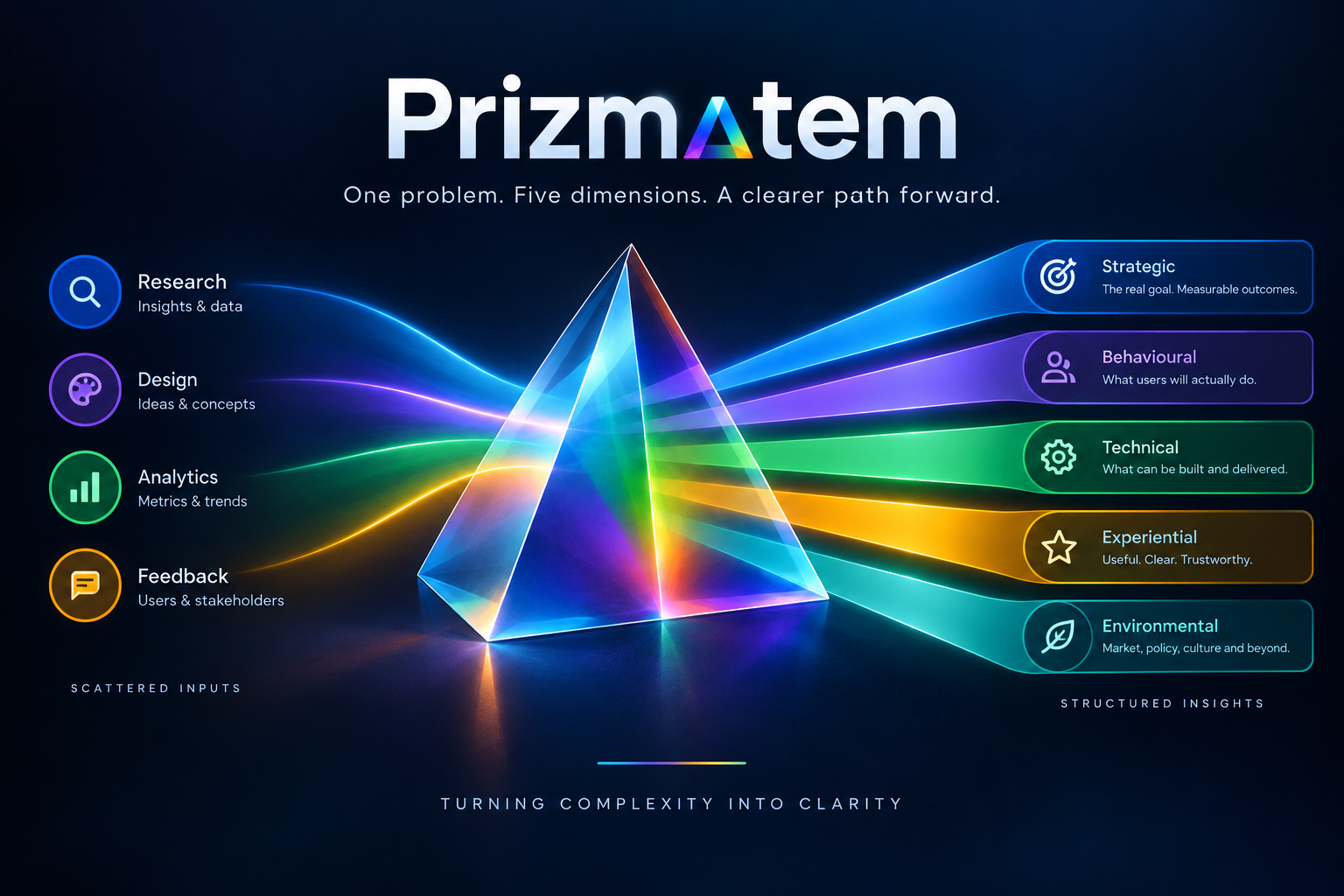
Prizmatem is a multidimensional framework that transforms scattered research, design inputs, analytics, and feedback into one structured working map. Instead of treating strategy, design, analytics, and delivery as separate tracks, it pulls them into a single model so teams can see what matters, what is connected, and what should happen next.
The name itself is a blend of “prism” and suffixes like “system” or “theorem.” A prism takes one input—white light—and refracts it into distinct, manageable layers. Prizmatem applies the same principle to project thinking: one messy problem goes in, and clear strategic, behavioral, technical, experiential, and environmental layers come out.
It exists both as a cognitive tool and, more recently, as a digital workspace. The philosophy came first. The software environment is the practical manifestation.
What the Term Actually Means (And Why There’s Confusion)
Prizmatem is not a single product with a company behind it. It is a conceptual framework that has been adopted across different domains—sometimes loosely, sometimes with more structure.
The primary use is the Creative and Strategic Framework. This is a mental model and digital workspace for knowledge workers, product teams, and creative professionals. It’s designed to reduce the friction of “work about work”—the time spent chasing updates, switching tools, and hunting for context.
A second interpretation appears in some sources: Prizmatem is described as a next-gen light-based communication system that transmits data via pulses of light—visible light, infrared, and ultraviolet—instead of radio waves. This description overlaps with optical wireless communication, a field that includes but is not limited to Li-Fi. However, this interpretation appears primarily in lower-authority tech blogs and lacks corroboration from academic or industry sources. Treat it as a claim requiring further verification, not an established fact.
A third interpretation describes Prizmatem as a smart material capable of controlling light, changing color, and adapting to its environment. Again, this appears in low-authority sources with no citation to peer-reviewed research. The underlying science of prismatic metamaterials and tensegrity structures is real and actively researched, but the specific branding of “Prizmatem” for these applications is not substantiated.
The institutional insight is this: the framework is where the documented value is. The light-based technology and the smart material claims require independent verification before they can be treated as established facts. Conflating them is an analytical error and a common one in low-quality content.
How the Prizmatem Framework Works
The framework operates on five dimensions. Every problem gets reviewed through each lens before any decision gets made.
Strategic: What business goal are you actually solving? Not the stated goal—the real one. Success metrics defined upfront.
Behavioural: What will users actually do? Not what they say they’ll do in a survey. What they’ll do at 11 PM when they’re tired and frustrated.
Technical: What can your stack, timeline, and team realistically support? Ambition without execution capacity is just noise.
Experiential: Does the result feel clear, useful, fast, and trustworthy? This is where most frameworks collapse. They optimize for delivery, not for the human on the other end.
Environmental: What outside factors—market shifts, policy changes, cultural context—could flip the outcome?
The framework also incorporates decomposition and refraction as its core operating principles. Decomposition breaks the problem apart. Refraction reveals different perspectives. The structure is repeatable without being rigid.
Pattern interrupt: Most project failures aren’t failures of execution. They’re failures of dimensional blindness. A team optimizes for the technical dimension while ignoring the behavioral one. The framework forces all five into the room.
What the Digital Workspace Looks Like
When manifested as a digital platform, Prizmatem is described as a visual workspace with maps, dashboards, scenario testing, and review tools that help teams compare options before committing budget, time, or development effort.
It is primarily described as a framework or philosophy, with digital-workspace implementations described in some sources. It should not currently be treated as a clearly established standalone software product. The philosophy can be applied mentally or embodied in tools. The ecosystem is fragmented.
Who it’s designed for: Creatives and designers breaking creative blocks. Business professionals making complex decisions. Educators deconstruct subjects for students. Anyone who regularly works with incomplete information and competing priorities.
Applications: Where the Framework Gets Real
For designers, Prizmatem keeps user experience, narrative, and interface logic connected. The problem with most design processes is that research lives in one tool, wireframes in another, and user feedback in a third. The framework consolidates these into scenario testing and review tools.
For marketers, it ties storytelling to analytics, brand consistency, and campaign feedback. The creative brief and the performance dashboard finally speak the same language.
For project managers, it turns loose ideas into priorities, owners, and measurable checkpoints. For cross-functional teams, it gives everyone a shared language for decision-making.
For sports analytics, the application is conceptual. The San Francisco Unicorns—an American professional Twenty20 cricket team competing in Major League Cricket—have invested heavily in a homegrown next-generation cricket intelligence platform called SFU AI. This platform is used for player recruitment, opposition analysis, matchups, and in-game tactics. A multidimensional lens would ask: Which players perform under pressure? What does the squad’s skill composition actually allow? How does fan experience shape performance? These are questions that data alone doesn’t answer. For a deeper look at how data and performance intersect in cricket, the story of KL Rahul’s resilience offers a useful case study.
Featured Snippets: Direct Answers
What is Prizmatem in simple terms?
Prizmatem is a multidimensional framework that breaks complex problems into five layers: strategic, behavioral, technical, experiential, and environmental. It exists as both a thinking tool and a digital workspace for teams that need to move from complex ideas to confident action.
Is Prizmatem a software product or a philosophy?
It is primarily described as a framework or philosophy, with digital-workspace implementations described in some sources. It should not currently be treated as a clearly established standalone software product.
Who should use Prizmatem?
Designers, marketers, product managers, data analysts, and anyone who regularly makes complex decisions with incomplete information. It’s particularly valuable for cross-functional teams that struggle with shared language.
What’s the biggest risk with Prizmatem adoption?
Process bloat. Teams that implement the framework without internalizing the philosophy end up with more meetings, more documentation, and no better decisions. The tool is not the mindset.
Is the light-based Prizmatem the same as the framework?
No. They share a name but are separate domains. The framework is a decision-making and creative strategy tool. The light-based technology is described in some sources as a photonics communication system, but this interpretation lacks corroboration from authoritative sources.
Prizmatem vs. Established Frameworks
| Feature | Prizmatem | Design Thinking | Jobs-to-be-Done | Lean Startup |
|---|---|---|---|---|
| Core structure | Five-dimensional | Human-centered | Customer needs | Experimentation |
| Strategic lens | Business goals | Empathy | Jobs | Build-measure-learn |
| Behavioural lens | User actions | Ideation | Motivation | Validation |
| Technical lens | Stack constraints | Prototyping | Context | Iteration |
| Experiential lens | Clarity & trust | Testing | Outcomes | Market learning |
| Environmental lens | External factors | — | — | — |
Prizmatem’s differentiation is the simultaneous five-dimension structure. Teams already using rigorous frameworks may find marginal returns, but the multi-lens approach offers value for cross-functional teams that struggle with dimensional blindness.
FAQs
Q1: What is Prizmatem in simple terms?
A: Prizmatem is a multidimensional framework that breaks complex problems into five layers: strategic, behavioral, technical, experiential, and environmental. It exists as both a thinking tool and a digital workspace for teams.
Q2: Where does the name “Prizmatem” come from?
A: It’s a blend of “prism” and suffixes like “system” or “theorem.” The etymology reflects its core function: taking a single complex subject and breaking it into distinct, manageable layers.
Q3: Is Prizmatem the same as the light-based data technology?
A: No. They share a name but are separate domains. The framework is a decision-making and creative strategy tool. The light-based technology is described in some sources as a photonics communication system, but this interpretation lacks corroboration from academic or industry sources.
Q4: How does Prizmatem apply to sports analytics?
A: It provides a structured way to evaluate data through multiple lenses—not just technical performance metrics, but behavioral patterns, strategic fit, fan experience, and environmental factors. The San Francisco Unicorns’ use of their SFU AI platform is a useful case study for multidimensional thinking.
Q5: What’s the difference between Prizmatem and generic strategy frameworks?
A: Most frameworks are linear or two-dimensional. Prizmatem forces five simultaneous dimensions. That’s the refraction principle—one input, multiple outputs, evaluated together.
Q6: Is Prizmatem a replacement for traditional project management tools?
A: No. It’s a layer above them. Prizmatem provides the multidimensional thinking structure. Tools like Asana, Monday, or Jira handle task execution. The framework tells you what to execute and why.
Q7: What industries are adopting Prizmatem fastest?
A: Digital product teams, creative agencies, and cross-functional enterprise strategy groups, based on the framework’s documented use cases.
Limitations and Risks
Process bloat. Every framework eventually becomes a bureaucracy. Teams that succeed with Prizmatem will be the ones that treat it as a thinking discipline, not a documentation requirement.
Learning curve. Five dimensions require discipline. Teams accustomed to linear workflows may struggle to adopt the multidimensional mindset without training and reinforcement.
Evidence of effectiveness. The framework is conceptually sound, but independent, peer-reviewed studies on measurable outcomes are limited. The claim about reducing “work about work” is based on industry surveys—notably Asana’s Anatomy of Work Index, which surveyed over 10,000 knowledge workers and found that 60% of a person’s time at work is spent on work about work and not on skilled work—not controlled experiments.
Software availability. The digital workspace is described in concept across multiple sources, but a single, officially branded product with clear pricing and enterprise support is not universally established. The ecosystem is fragmented.
Unverified claims. The light-based technology and smart material interpretations of Prizmatem appear primarily in low-authority sources and lack corroboration from academic or industry publications. Until independently verified, they should be treated as speculative.
Conclusion: What to Do With This
If you’re evaluating Prizmatem for your team: Start with the philosophy, not the software. Use the five dimensions as a pre-mortem checklist before any major initiative. If you can’t articulate your position on each dimension, you’re not ready to commit resources.
If you’re a content creator or strategist: The refraction principle is your ally against creative block. Take one input—a brief, a problem, a constraint—and refract it through each dimension. The solution usually lives at the intersection.
If you’re a sports organisation: The San Francisco Unicorns’ data experiment is worth watching. Their SFU AI platform is a central pillar of their cricketing decision-making. If they crack the code of turning analytics into consistent on-field performance, every MLC franchise will follow. If they don’t, the lesson will be that data without multidimensional thinking is just expensive noise.
About the Author