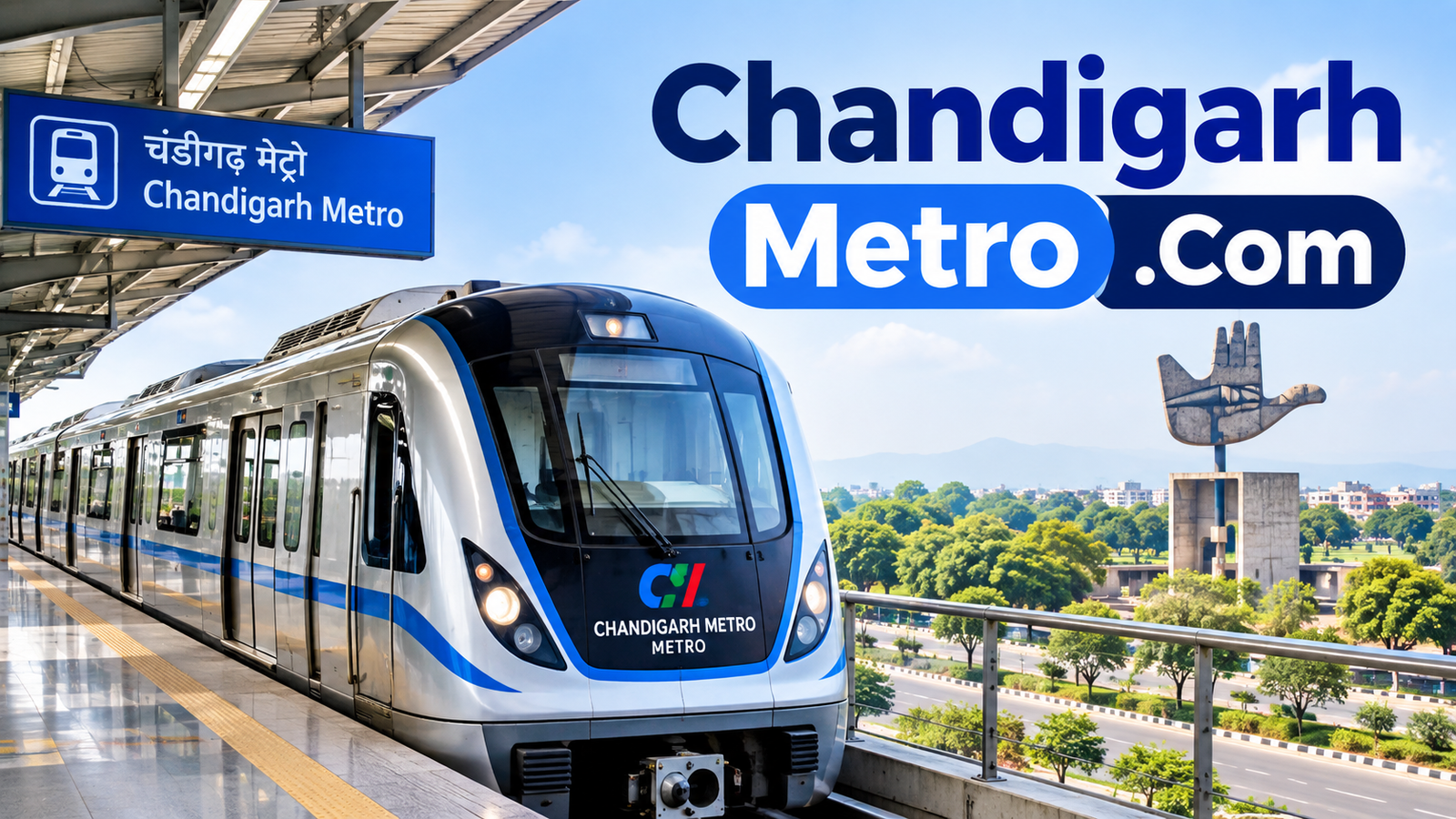
Chandigarh Metro .Com: Founder, History, Business Model & 2026 Analysis
Chandigarh Metro .Com is a hyperlocal news and information portal covering Chandigarh and the surrounding Tricity region. The domain was registered on September 29, 2011, and launched as a news site in October 2014. The website identifies Ajay Deep as the founder of Chandigarh Metro. The site publishes local news, events, and city information, and third-party guest-post marketplaces currently list it for paid placements starting at approximately $55 per insertion.
That is the documented entity. What follows is analysis clearly separated from verified facts.
Official Website & Contact Information
Registered entity: CHANDIGARH METROMEDIA PRIVATE LIMITED, incorporated on October 6, 2016, with CIN U74999CH2016PTC041245. The registered address is H. No. 1244, Sector-19B, Chandigarh, 160019. The company’s email is ajay@chandigarhmetro.com. The company status is listed as Active, with the last balance sheet filed on March 31, 2019.
Founder contact: WHOIS records for chandigarhmetro.com list Ajay Deep as the registrant contact.
Advertising: Third-party marketplaces list ChandigarhMetro.com for paid PR and guest post placements, with one listing offering a placement for $55. A separate listing shows a guest post at $330.
Verified Entity Facts (Before Any Analysis)
Who founded Chandigarh Metro.com?
The site identifies Ajay Deep as the founder of Chandigarh Metro. His Product Hunt profile lists him as “Founder & CEO, Chandigarh Metro.” WHOIS records confirm Ajay Deep as the domain registrant.
When was it founded?
The domain was registered on September 29, 2011. The site launched as a Chandigarh news platform in October 2014 and expanded coverage to Punjab, Haryana, and Himachal Pradesh in 2015.
What does it publish?
Local Chandigarh news, events, city information, and a magazine section. The site describes itself as “the first and the largest local news website of Chandigarh.”
What does the historical About page say about operations?
The site’s own historical About page states that during its early development, Ajay Deep handled “everything… starting from the concept behind Chandigarh Metro, its web design, web development, content writing, content editing, clicking photographs, overall website management, marketing, and social media.” That historical operating model should not automatically be treated as the company’s current 2026 staffing structure. The registered company, Chandigarh Metromedia Private Limited, was incorporated in 2016, suggesting an evolution from a solo operation to a formal corporate entity.
What traffic does the site claim?
The About page has historically claimed figures including “200,000 page views per month” (July 2016 update) and “5,000,000 page views” monthly (November 2017 update). These are self-reported figures and should be treated as such, not independently audited.
What do third-party estimators say?
Third-party estimates vary wildly. Hypestat estimates approximately 76,598 monthly visits and 2,528 daily unique visitors. Statscrop lists 400 visitors with a global rank of #15,475,851. SiteWorthTraffic estimates a website value of $6,270 with 91,620 monthly unique visitors. The spread across these estimates is wide enough to be unhelpful.
What ties these estimators together?
The inconsistency itself is the signal. Nobody outside the operator knows the real number. Third-party traffic estimators in this tier function as directional indicators, not audited metrics. The most defensible conclusion is that the site’s true audience size is unverified by any independent party.
The Business Model: What the Evidence Supports
Does Chandigarh Metro.Com sell placements?
Yes. Third-party guest-post and PR marketplaces currently list ChandigarhMetro.com for paid placements. Online PR offers a placement for $55, describing it as “Publish PR, Guest Post On Chandigarh Metro.” Adbassador lists a guest post option for the site as a “Local News” domain.
This suggests that sponsored or commercial publishing forms part of the site’s broader monetization ecosystem. It does not prove that paid placements are the only revenue source, nor does it establish the site’s total revenue.
What is the underlying value proposition?
A business featured in a Chandigarh Metro article receives a searchable, indexable asset with a local domain’s editorial context. For a salon, clinic, or local service provider, this functions as a digital trust signal—searchable proof of coverage on a site that has operated in the Chandigarh market for over a decade.
That is the product. Not journalism. Not traffic. Searchable local trust.
What competes for that attention?
| Channel | What It Competes For |
|---|---|
| Google Search | Search visibility for local queries |
| Google Business Profiles | Direct local business discovery |
| Instagram/YouTube creators | Visual proof and short-form discovery |
| WhatsApp referral loops | Personal, trust-based referrals |
| National publishers | News, information, and general awareness |
| Chandigarh Metro.com | Local information + commercial visibility |
These are not all direct competitors. They compete for different stages of the local discovery journey. Google Business Profiles, for example, serve a transactional discovery function for a user searching for a nearby business and wanting directions or reviews. Chandigarh Metro serves an informational and reputational function a user searching for context and credibility signals about a business. The channels overlap at the decision stage but not at the research stage.
The Google 2026 Discover Update: What It Actually Says
What did Google announce?
On February 5, 2026, Google released the February 2026 Discover core update. Google’s own announcement states the update would (1) show users more locally relevant content from websites based in their country, (2) reduce sensational content and clickbait, and (3) show more in-depth, original, and timely content from websites with expertise in a given area, assessed on a topic-by-topic basis.
Google specifically noted that “a local news site with a dedicated gardening section could have established expertise in gardening, even though it covers other topics.” The rollout completed on February 27, 2026, after roughly 22 days.
Does this update benefit Chandigarh Metro .Com?
That is an inference, not a Google-confirmed fact. Several elements of Google’s February 2026 Discover guidance particularly local relevance and original, in-depth coverage are potentially compatible with Chandigarh Metro’s publishing model. Whether the site actually benefits depends on content quality, entity signals, and whether it meets Google’s topical expertise threshold. Google has not evaluated this site publicly.
Read Also: Most Runs in ODI Cricket/ Shubman Gill
What language should be used?
“Why Google’s February 2026 Discover Changes Could Benefit Hyperlocal Publishers” is safer and more accurate than asserting the update is a “tailwind” for this specific site. The distinction matters for credibility.
The AI Overview Squeeze: A Structural Risk
How much have AI overviews reduced clicks?
Ahrefs research published in February 2026 found that AI Overviews reduce the organic click-through rate for position-one content by approximately 58%. Neil Patel’s analysis of over 2,000 keywords found that position-one CTR drops from 24.9% without AI Overviews to 18.6% when they are present.
The impact extends beyond position one. Pages in position two lost about half their clicks, and even pages ranking tenth saw drops of nearly 20%.
What does this mean for a site like Chandigarh Metro .com?
If the site’s acquisition depends on organic search visibility, the AI Overview rollout compresses the funnel. A local business searching for “best salon in Chandigarh” may receive a direct AI-generated answer without clicking through to a Chandigarh Metro article.
This is not a hypothetical. Press Gazette’s May 2026 ranking shows Hindustan Times dropped 54% year-on-year to 122.2 million visits. Indian Express fell 40%. These are national publishers with vastly more resources than a hyperlocal operation, and they are still bleeding traffic.
The Operator’s Risk Register
Concentration risk. If sponsored placements form a significant revenue share, a single algorithmic shift or a reputational hit to the “sponsored content” category can compress the funnel. Google’s Discover update explicitly reduces sensational and clickbait content; if paid placements read as promotional, they are vulnerable.
Organizational fragility. The historical About page describes a one-person operation during the site’s early development. The registered company was incorporated in 2016, suggesting a transition to a formal corporate structure, but the publicly available records show limited recent filings the last balance sheet was filed for the year ending March 31, 2019. The current operational scale is not publicly documented.
Bounce rate and engagement. Third-party estimates suggest high bounce rates, though the available data is inconsistent. A drive-by audience with low engagement does not compound. If the traffic source shifts, there is no retention layer to fall back on.
AI Overview compression. As demonstrated above, AI Overviews reduce click-through rates across all positions. For a site whose value proposition includes searchable visibility for featured businesses, this is a direct threat to the placement product.
The archive liability. Old articles that no longer demonstrate strong originality, accuracy, usefulness, or topical expertise become dead weight in the index. Legacy pages can drag down site-wide signals if they fail Google’s quality thresholds.
What a Real 2026 Action Plan Looks Like
1. Build entity density, not content volume.
Google’s 2026 systems reward topical clusters and demonstrated expertise. Chandigarh Metro .Com should own two or three verticals—completely local services, education, and events—and build structured entity pages (Organization, LocalBusiness, and Person schema) around every featured business. This makes the archive queryable by AI systems, not just crawlers.
2. Convert one-off placements into recurring retainers.
A $55 one-time placement is a transaction. A quarterly “Local Business Spotlight” package with refreshed content, social distribution, and a verified badge is a subscription. This aligns with where Indian publishers are shifting: from reach to retention.
3. Build a WhatsApp distribution layer.
Hyperlocal audiences in India respond to WhatsApp more than email. A daily or weekly digest to a segmented list converts drive-by search traffic into a re-engageable asset. This is the retention layer the site currently lacks.
4. Use the archive as a moat, not a museum.
Every old article should link to a current “best of” roundup in the same category. Internal linking from legacy content to fresh content is the cheapest SEO lift available, and it is the kind of structural move that AI Overviews cannot replace.
5. Invest in retention before acquisition.
The traffic collapse affecting national publishers is a content problem for them. For Chandigarh Metro .Com, it is an infrastructure problem. Building direct reader relationships would reduce the site’s dependence on search-driven acquisition. The operators who build those relationships first will be better positioned to weather the next search disruption.
Featured Snippet Answers
Is Chandigarh Metro .Com a legitimate news source?
It is a hybrid: part local news portal, part sponsored content platform. The site publishes editorial pieces and paid placements under a unified brand. Legitimacy comes from local search relevance and over a decade of operation, not journalistic credentialing.
How does Chandigarh Metro .Com make money?
Through sponsored business features, press release placements, and local advertising. Third-party marketplaces list placements starting at approximately $55. The business model resembles local PR distribution more than traditional media advertising.
Will Chandigarh Metro .Com survive the AI Overview era?
Survival depends on execution. The site is structurally positioned to benefit from Google’s local-relevance push. But it lacks a reader-retention layer, which makes it vulnerable to acquisition-source volatility. National publishers with far more resources are already losing 50%+ of traffic year-on-year.
What is the traffic profile of Chandigarh Metro .Com?
Third-party estimates range from 400 to 91,620 monthly visitors. The site’s own About page has historically claimed over 10,00,000 monthly readers, but those claims are undated and self-reported. No independent audit of traffic has been published.
Who owns Chandigarh Metro .Com?
Ajay Deep, founder of Chandigarh Metro. The registered entity is Chandigarh Metromedia Private Limited (CIN U74999CH2016PTC041245), incorporated in October 2016. The registered address is Sector-19B, Chandigarh.
Is Chandigarh Metro .Com the same as the Chandigarh Metro rail project?
No. The website is a news and information portal. The Chandigarh Metro rail project is a separate public transit initiative. The site covers the project as news, but it is not affiliated with the transit authority.
What should local businesses know before paying for a placement?
Verify the article’s indexing status, ask for internal linking terms, and negotiate for a refresh clause. A one-time placement decays. A placement with ongoing distribution is an asset.
Conclusion: The Infrastructure Play That Needs Infrastructure
Chandigarh Metro .Com is a case study in what local digital publishing looks like when the operator understands that the product is not content — it is access to trust. The business has survived for over a decade on a lean model that most VC-backed publishers would dismiss as too small. But survival is not the same as relevance.
Several elements of Google’s February 2026 Discover guidance — particularly local relevance and original, in-depth coverage — are potentially compatible with Chandigarh Metro’s publishing model. The opportunity is to stop treating the archive as a byproduct and start treating it as the core asset.
That means entity pages, topical clusters, retention channels, and a monetization model that moves from one-off placements to recurring visibility packages.
The action strategy is straightforward: own two verticals completely, build a WhatsApp layer, and convert the archive into a queryable database of local trust. The traffic collapse affecting national publishers is a content problem for them. Chandigarh Metro .Com’s problem — and its opportunity — is an infrastructure problem. Building direct reader relationships would reduce the site’s dependence on search-driven acquisition, and that is the most defensible position for a hyperlocal publisher in 2026.
About the Author

2 thoughts on “Chandigarh Metro .Com: Founder, History, Business Model & 2026 Analysis”